| |
| |
1. entering
You are asked to give your name after 10:00 pm.
A house constitutes a body of images that give mankind proofs or illusions of stability. We are constantly re-imagining its reality: to distinguish all these images would be to describe the soul of the house; it would mean develop- ing a veritable psychology of the house.
A house is imagined as a vertical being. It rises upward. It differentiates itself in terms of its verticality. It is one of the appeals to our consciousness of verticality.
A house is imagined as a concentrated being. It appeals to our con- sciousness of centrality. Verticality is ensured by the polarity of cellar and attic. I would like there to exist places that are stable, unmoving, intangible, untouched and almost untouchable, unchanging, deep-rooted; places that might be points of reference, of departure, of origin.
To describe space: to name it, to trace it, like those portolano-makers who saturated the coastlines with the names of harbours, the names of capes, the names of inlets, until in the end the land was only separated from the sea by a continuous ribbon of text. Is the aleph, that place in Borges from which the entire world is visible simultaneously, anything other than an alphabet?
Space as inventory, space as invention. Space begins with..5
Before, there was nothing, or almost nothing; afterwards, there isn’t much, a few signs, but which are enough for there to be a top and a bottom, a beginning and an end, a right and a left, a recto and a verso. Elephants are generally drawn smaller than life size, but a flea always larger.
Force yourself to see more flatly.
Space is not a discursive, or as one says, general concept of relations of things in general, but a pure intuition. For, firstly, one can represent only one space, and if one speaks of many spaces, one thereby understands only parts of one and the same unique space. These parts cannot precede the one all-embracing space as being, as it were, constituents out of which it can be composed, but can only be thought as in it. It is essentially one; the manifold in it, and therefore also the general concept of spaces, depends solely on limitations.
2. resting/staying
The whole arrangement is established. The end of which is that there is a suggestion, a suggestion that there can be a different whiteness to a wall. This was thought. The surroundings were unrecognizable—except for the white wall. His heart was beating as after an arduous climb. At the entrance he nearly fell over, as behind the door there was another step. ‘They don’t show much concern for the public,’ he said.
We use our eyes for seeing. Our field of vision reveals a limited space, something vaguely circular, which ends very quickly to left and right, and doesn’t extend very far up or down. If we squint, we can manage to see the end of our nose; if we raise our eyes, we can see there’s an up, if we lower them, we can see there’s a down. If we turn our head in one direction, then in another, we don’t even manage to see completely everything there is around us; we have to twist our bodies round to see properly what was
6
behind us. Our gaze travels through space and gives us the illusion of relief and distance. That is how we construct space, with an up and a down, a left and a right, an in front and a behind, a near and a far.
When we concentrate on a material object, whatever its situation, the very act of attention may lead to our involuntary sinking into the history of that object. Novices must learn to skim over matter if they want matter to stay at the exact level of the moment. Transparent things, through which the past shines!
In point of fact, we are in the unity of image and memory, in the functional composite of imagination and memory. The vision is not hermetic. Windows allow for discourse with the outside. Random process—what you see through the window—is precisely framed.
When nothing arrests our gaze, it carries a very long way. But if it meets with nothing, it sees nothing, it only sees what it meets. Space is what arrests our gaze, what our sight stumbles over: the obstacle, bricks, an angle, a vanishing point. Space is when it makes an angle, when it stops, when we have to turn for it to start off again. There’s nothing ectoplasmic about space; it has edges, it doesn’t go off in all directions, it does all that needs to be done for railway lines to meet well short of infinity. The corner is a sort of half-box, part walls, part door. Consciousness of being at peace in one’s corner produces a sense of immobility, and this, in turn, radiates immobility. An imaginary room rises up around our bodies, which think that they are well hidden when we take refuge in a corner. Already, the shadows are walls, a piece of furniture constitutes a barrier, hangings are a roof.
Je suis l’espace où je suis.
This is a great line. But nowhere it can be better appreciated than in a corner.
(Life is probably round.) Force yourself to see more flatly.
The whole arrangement is established. The surroundings were unrecog- nizable—except for the white wall. His heart was beating as after an arduous
7
climb. At the entrance he nearly fell over, as behind the door there was another step. ‘They don’t show much concern for the public,’ he said.
The room was long but narrow with one window. There was no direct source of light but it was not entirely dark as many of the departments, instead of solid walls, had just wooden bars reaching up to the ceiling to separate them from the corridor. It was a tiny little cubbyhole of a place, no more than six paces long, and so low that anybody of even a little more than average height felt uncomfortable in it, fearful that at any moment he might bump his head against the ceiling. The yellowish dusty wall-paper peeling off the walls gave it a wretchedly shabby appearance, and the furniture
was in keeping; there were three rickety chairs and a stained deal table in a corner, holding a few books and papers so covered with dust that it was plain that they had not been touched for a long time; and lastly there was a large and clumsy sofa, taking up almost the whole of one wall and half the width of the room, and with a print cover now old and worn into holes. The only light in the room came through a little window that was so high up that, if you wanted to look out of it, you first had to get one of your colleagues to support you on his back, and even then the smoke from the chimney just in front of it would go up your nose and make your face black. In the floor of this room—to give yet another example of the conditions there—there was a hole that had been there for more than a year, it was not so big that a man could fall through, but big enough for your foot to disappear through it.
Either it was very deep, or she fell very slowly, for she had plenty of time as she went down to look about her, and to wonder what was going to happen next. First, she tried to look down and make out what she was coming to, but it was too dark to see anything; then she looked at the sides, and noticed that they were filled with cupboards and bookshelves: here and there she saw maps and pictures hung upon pegs. There were corridors that led nowhere, unreachably high windows, grandly dramatic doors that opened onto monklike cells or empty shafts, incredible upside-down staircases with upside-down treads and balustrades. Other staircases, clinging airily to the side of a monumental wall, petered out after two or three landings, in the high gloom of the cupolas, arriving nowhere.
At the end of one corridor, I saw a circle of sky so blue it was almost purple. Under the step, toward the right, I saw a small iridescent sphere of almost unbearable brightness. At first I thought it was spinning; then
8
I realized that the movement was an illusion produced by the dizzying spectacles. In that unbounded moment, I saw millions of delightful and horrible acts; none amazed me so much as the fact that all occupied the same point, without superposition and without transparency.
Indeed the presence of that odd piece of furniture, your own body, seems superfluous, an intrusion. The space offers the thought that while eyes and minds are welcome, space-occupying bodies are not—or are tolerated only as kinesthetic mannequins for further study. I am sitting in a room different from the one you are in now. I am never here only, as this encapsulated body; rather, I am there, that is, I already pervade the room, and only thus can I go through it.
A fact is that when the place was replaced all was left that was stored and all that was retained that would satisfy more than another. The question is this, is it possible to suggest more to replace that thing. This question and this perfect denial does make the time change all the time.
I am sitting in a room different from the one you are in now.
3. exiting/Leaving
A measure is that which is put up so that it shows the length has a steel construction. Tidiness is not delicacy, it does not destroy the whole piece, certainly not it has been measured and nothing has been cut off and even if that has been lost there is a name, no name is signed and left over, not any space is fitted so that moving about is plentiful. Why is there so much resignation in a package, why is there rain, all the same the chance has come, there is no bell to ring. The uninhabitable: the skimped, the airless, the small, the mean, the shrunken, the very precisely calculated.
Is there another language? Is there a language of actions, a language of sounds—a language of word-as-part-of movement?
9
Force yourself to see more flatly.
Resign yourself to ennui. No matter your choice, you’ll wish to be somewhere else. Which is ennui. Get to it before it gets to you. You’ll recognize it. Ignore any path that would seem to give you advantage, in terms of amusement or some kind of good use of the time. Look to the left. Find it tedious. Proceed to the right with the sun assaulting your pates. Immediately on changing the subject of conversation, run out of energy. Don’t give in to understanding. Let the day drag on. Here is the city, with its streets and houses, with the river, with the parks, here is a lake, here is the railway track, here are the plain and the plateau, here is the hill. I dream of driving around in the desert with a thousand miles of empty space on every side.
Space is what prevents everything from being in the same place.
Language is what prevents everything from meaning the same thing. What would be the use, for instance, in giving the plan of the room that was really my room, in describing the little room at the end of the garret, in saying that from the window, across the indentations of the roofs, one could see the hill. I alone, in my memories of another century, can open the deep cupboard that still retains for me alone that unique odor, the odor of raisins drying on a wicker tray.
‘I want to go, what is the way to the exit?’ ‘You haven’t got lost, have you?’ asked the usher in amazement, ‘you go down this way to the corner, then right down the corridor straight ahead as far as the door.’ ‘Come with me, show me the way, I’ll miss it, there are so many different ways here.’ ‘It’s the only way there is,’ said the usher, who had now started to sound quite reproachful, ‘I can’t go back with you again.’
So we moved, and they, in a formal pattern, Along the empty alley, into the box circle, To look down into the drained pool. Dry the pool, dry concrete, brown edged, And the pool was filled with water out of sunlight, And the lotos rose, quietly, quietly,
10
The surface glittered out of heart of light, And they were behind us, reflected in the pool. Then a cloud passed, and the pool was emtpy. Go, said the bird, for the leaves were full of children, Hidden excitedly, containing laughter. Go, go, go, said the bird: human kind Cannot bear very much reality. Time past and time future What might have been and what has been Point to one end, which is always present.
11
12
seeing it
stop.
Look to the left. observe the scene. apply yourself. take your time.
Keep looking to your left, for about a minute.
then describe.
either the moment: or a detail of what you saw: note down the place: the time: the weather:
13
stop.
Look to the left. observe the scene. apply yourself. take your time.
Keep looking to your left, for about a minute.
then describe.
the time the weather
stop.
Look to the left. observe the scene. apply yourself. take your time.
I see transparent squares that are connected. Hori- zontally there are two and a half together and verti- cally four and a half. They are framed by darkness but light shines through. I look and I stare and I ob- serve the sky behind. A tip of a rooftop and contour of a flower.
9:46 am
Stormy __________________________
14
Keep looking to your left, for about a minute.
then describe.
note down the place
There is a white box full of soft children’s hats. I don’t have any children. There are seven blue photo albums. No labels, no noth- ing, only a golden scout lily on each spine. I never joined the boy scouts. There is a Bantex-folder and an Egla-folder, seemingly bursting with receipts and forms and such. I’ve never completed my own income tax return.
There are two folders with recipes. Below, an- other folder with recipes. Beside it eleven recipe books; Pasta Dishes, Home- made Bread, Oven Courses, Expecting Visitors?, A Hearty Meal I and II, The Cake Book, The Bread Book, The Barbeque Book, Cheese Delight, The Silver Spoon. I need help with making tea.
I am at my sister’s house. These are four of the sixteen shelves to my left. They make up a square shelf complex, on wheels.
I have my car keys ready.
15
the time the weather
stop.
Look to the left. observe the scene. apply yourself. take your time.
Keep looking to your left, for about a minute.
then describe.
note down the place the time the weather
Skeiðarvogur 35, Reykjavik, end house, top entrance, first room on the right
December 28th at 11:26 pm
Christmas snow __________________________
Why would they design the seats in the tram so that every person’s feet dangle loose in the air, returning them to childhood?
Tram line 8, Rome 8:01 am
Mild _________________________
16
stop.
Look to the left. observe the scene. apply yourself. take your time.
Keep looking to your left, for about a minute.
then describe
My looking left makes sense here, because my uncle and aunt are proud right-wing Republicans. (I am not, and am as queer as I am in my normal home of Greenpoint, Brooklyn.) They spoke about their love of Fox TV and O’Reilly over dinner last night. This was only after we joined hands at the din- ner table, (of a local sub- urban Chinese restaurant) to say grace. I will spend the day with my uncle and aunt, and will then meet up with my friends for din- ner and a gothic/industrial party that normally takes place in NYC. This will
be a big art after-party for the art fair, Miami Basel. The party is called ‘Weird.’ This second part of the day should be fun.
When I look left, I see my blurred reflection in
17
note down the place
the time the weather
stop.
Look to the left. observe the scene. apply yourself. take your time.
Keep looking to your left, for about a minute.
the mirrored portion of the bedroom’s armour.
I’m in Miami, Florida at my uncle and aunt’s house, sleeping in my cousin’s bed. My uncle recently woke me up, as per a former military tradition (he was a marine) that never wore off.
8:15 am
It’s cool here, in a par- ticular way that I remember from visiting as a child. Central air conditioning
+ humidity and an aware- ness of a more tropical landscape outside, via the smell of plants. _________________________
18
then describe. note down the place
the time the weather
stop.
Look to the left. observe the scene. apply yourself. take your time.
Keep looking to your left, for about a minute.
then describe.
A gradient of light taken by the columns of a foyer.
Avery Fischer Hall, viewed from the second level of the New York Public Li- brary.
December 4th at 11:42 am
Sunny, 51° F _________________________
These are the objects sitting to my left on the honey-hued desktop: a glue- stick, two red notebooks, a black notebook, a stack of receipts, three very sharp pencils, a pencil sharpener, a biro, a pair of woolen gloves turned inside-out, a leather wal- let with a bank-card poking
19
out (the Brandenburger Tor is rendered on the plas- tic bank card in silvery tones, the overlapping blue and red circles forming
the bank’s logo could be suns setting behind the monument), an eraser, a postcard of a volcano, a pile of bills, torn and empty envelopes, my mobile phone, headphones, scraps of paper on which lists
of names and times and activities are written, a shopping list scrawled on the back of an envelope, a folded photocopy showing an engraving of dead Christ’s legs and the folds of his shroud, a five-colour-in- one fluro highlighting pen, a scruffy address book, a play-script in a battered folder, an ipod in a purple sock, two empty transparent plastic folders, a metal clip, an A5 pad on which the following is written in pencil: ‘also concerned with the idea of BELONGING, of making, of having a HOME / also a figure arrives in a community, works his way in, wants to stay / Len
= more of a blank / the ideology of HOMEMAKING. ie
20
note down the place
the time the weather
stop.
Look to the left. observe the scene. apply yourself. take your time.
Keep looking to your left, for about a minute.
Home Is The Most Important Place In The World (Ikea billboard) / Different steps in cycle (formation / atrophy / disintegra- tion / RENEWAL) / Collaps- ing system or inherent in system?’, in the top right hand corner of that A5 page is a doodle (also in pencil) of a hole, lastly, I see, eraser shavings, and a strand of black hair.
An apartment in Prenzlauer Berg, Berlin
12:12 am
4°, still, clear skies. _________________________
21
then describe.
note down the place the time the weather
stop.
Look to the left. observe the scene. apply yourself. take your time.
Keep looking to your left, for about a minute.
then describe.
Empty big playground, a few tires hanging from a wooden structure, bare trees, a man sweeping leaves
at the very far end, but really at the end, far from here, inside the building, the children.
Manteuffelstraße, Berlin 11:00 am
Strangely sunny _________________________
After turning to my left and facing towards the space in between the dining table and the bookshelf against which my bike is resting, looking ostensibly at the left side of the wooden fireplace and count-
24
note down the place
the time the weather
ing for a few seconds in an attempt to roughly gauge a minute, I started to relax and focus on the sound of the light rain outdoors
as it hit the windows, the cars driving and also the sound of a man’s voice, coming seemingly from a television and accompanied by the slow repetitive bass of what was likely a video game soundtrack being played in the apartment above. I forgot that I had been counting and in time forgot about the rain and the bass and more or less everything else until I turned back to the computer and looked at the time and completely forgot when it was I had originally turned away.
My living room, Brooklyn, New York
10:10 pm
Raining __________________________
25
stop.
Look to the left. observe the scene. apply yourself. take your time.
Keep looking to your left, for about a minute.
then describe.
note down the place
the time the weather
stop.
Look to the left. observe the scene. apply yourself. take your time.
Keep looking to your left, for about a minute.
Clashing decor, teetering end tables three couches obtrusive DIY TV console I placed a stool underneath of the ceiling fan. Because needed it to reach the cord.
Brooklyn
Saturday, late-morning, it must have rained last night. __________________________
26
then describe.
At my left this grey short-day-time-morning is 1) Thick and hard homemade bread; 2) Potassium Powder for chronic fatigue syn- drome cases 3) Espresso- machine, I had to stop drinking coffee but I still miss it and today I decided to drink it to make the day more blue; 4) Old flowers that a friend gave me two days ago, they are purple in color for the fusion mind, 5) Pseudo-hammond organ covered with note- books and vitamin bottles; 6) Transparent plastic bag with a red silk ribbon and inside is a white anis cake from Basel in Swit- zerland, on the cake there is stamped a picture of a middle-aged man or fool with a dog with a black dead rat in its mouth. 7) Myrrh stones.
27
stop.
Look to the left. observe the scene. apply yourself. take your time.
Keep looking to your left, for about a minute.
then describe.
Through the windows of Starbucks, I see the area where people wait for the elevators, make calls on the public phones, or visit the bathroom. This area
is lit with a combina- tion of cool light from low-energy bulbs and a peachy brightness from intermingling halogens. The entire space, except for the white-painted ceil- ing, is surfaced with shiny speckled granite. There is a steady flow of people here: buying smoothies
from the juice bar, picking up photos from the Kodak store, buying Starbucks, waiting for the elevators to take them up one of the forty odd stories of the office tower above, or the parking garage below. A hand-sanitizer dispenser hangs on the wall next to
28
note down the place
the time
stop.
Look to the left. observe the scene. apply yourself. take your time.
Keep looking to your left, for about a minute.
then describe.
the elevator control-panel, above an aluminum garbage can. The only people stay- ing in this space for more than, say, two minutes, are the cleaning staff.
Starbucks Coffee, 2nd floor, Muang Thai-Phatra Office Tower 2, Ratcha- dapisek Rd, Bangkok, Thailand.
January 7th at 10:47 am __________________________
A wall with woodchip wall- paper, grey shadows fall- ing toward the right. The arrangement of some chips suggests a spidery man with upraised arms. Beneath him, some deer, disappearing.
29
note down the place
the time the weather
Plus a deer skull, lying on its side, to the left, under an eye within a sea- shell.
Longitude 11.558 E, latitude 48.153 N
1:40 pm
Partly cloudy, low sun __________________________
30
stop.
Look to the left. observe the scene. apply yourself. take your time.
Keep looking to your left, for about a minute.
then describe.
note down the place the time the weather
Through a round window – endless white wilderness in the moonlight. Mist on the horizon. Polar star in the night sky.
A frozen river like a snake through the landscape.
Siberia December 5th at 3:49 am
Calm, 55° Speed: 876 km/h __________________________
31
32
fragmentations of sPace or: to seParate anD shift, to refLect, to PLay
0. i am sitting in a room different from the one you are in now.1
In 1969, Alvin Lucier recorded the sound piece I am Sitting in a Room, which consists of a short text that is both a description of the piece and its material. While speaking, Lucier recorded his own voice on tape, played it back, and then recorded the playback. With every subsequent playback, the resonant frequencies of the room become louder and louder, and as they accumulate, they ultimately drown out the spoken text; instead, one hears the ‘natural resonant frequencies of the room articulated by speech,’2 the sound of the room, with Lucier’s voice resonating in it. This process of revealing normally imperceptible characteristics of a room finds a parallel in Lorenzen’s practice. When confronted with his works, the viewer quickly realizes that Lorenzen deals with spatial perception on a very fundamental level, consistently making attempts to destabilize it, and experimenting with the ways in which we use and understand space.
33
1. to separate and shift
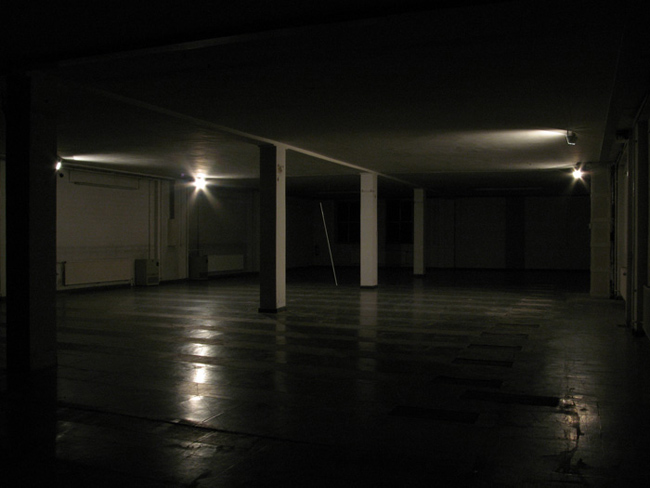
In Converge (2008), for example—one of Lorenzen’s impossible to document works—visitors enter an empty hall through a door that has been left ajar. This door closes after someone enters and then remains closed for five minutes, which, when one is alone in a room, feels
like a very long time. Gradually, one realizes that the light is slowly fading out and, as the room gets darker, the sound seems louder. It is a bit eerie, as a milky, dim atmosphere takes over the white cube, gradually becoming grayer, until finally, everything seems to disappear. The space, however, resonates at an increasingly loud level, until it
is almost intolerable—but just as it is about to reach an unbearable moment, the light turns on, and the room is once again quiet. Blinking and confused, the visitor stumbles toward the exit, only to later wonder what has actually happened.3
Converge plays with the visitor’s perception and his expectation that when he goes to an art exhibit, he will be faced with concrete works. However, the space itself replaces the artworks in the role of protagonist, as it is ‘dissected’ into its individual elements, which, in turn, forces visitors to abandon habitual, almost automatic, ways of perceiving space. In the course of the artist’s careful choreography, the eyes are the first to fail into the darkness; then, slowly, the ears are engaged, while the amplification of sound affects the whole body. One can no longer sense the size of the room, and instead clings to the recollection of what the space was like in the light.
With works like Converge, Lorenzen disturbs the habitual handling of space. Normally, one is busy looking around, greeting other people, or focusing on finding the right door, instead of concentrating on the surroundings. Space is perceived as a framework for action, and its presence as self-evident. However, it is constituted by the perception of small changes, by the body oriented in space, and thus is proces- sual—something that is always in the process of becoming.4 Or, to put it another way, space is not a fixed entity; rather, it is performative, understood through processes of questioning and comparing. It is precisely this aspect that Lorenzen emphasizes, as he dissects space and reassembles the elements constituting it, such as light and sound,
34
employing sensory perception and experiences as his construction materials. Instead of using space as a container for another action, he presents aspects of space as such.
Parallels to the way that Lorenzen isolates individual elements of space can be found in works by Olafur Eliasson, who splits up the color spectrum, for example, and then works with the ‘pieces,’ ultimately guiding the senses so that they perceive things in completely different ways. Take, for instance, Eliasson’s Room for One Color (1997), in which a yellow light turns every visitor into a gray character as if he had emerged from a black-and-white film. Whereas Eliasson deliberately manipulates physical laws to add a new dimension to the multiple layers of sensory perception and to expand the sense of sight, Lorenzen sends his viewers into the darkness, experimenting with sound and light, relying on reduction, concentration, and often on deliberate irritation. Through subtle interventions the space is fragmented, dissected into individual pieces. Now, this fragmentation should not be regarded as subtraction, as a way of reducing the number of aspects constituting a space, but as a way of shifting them and thus changing the focal points.
2. to reflect
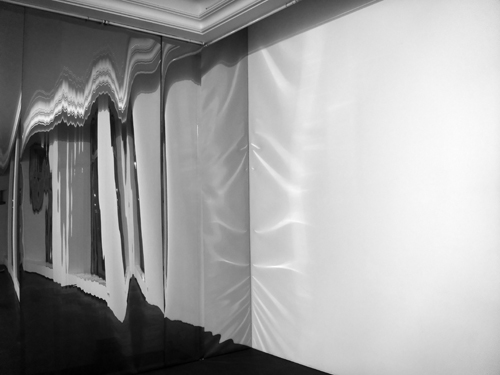
Shifts are also important to Lorenzen’s Viewpoint Pieces, a series of photographs mounted behind thick glass plates. From a particular standpoint, the content of each photograph is seen as a precise reflection of something in the room. In Round Here (2007) for instance, Lorenzen hangs a light bulb just above the floor, along with a small motor that makes the bulb revolve. The photos on all four walls of the room show the reflections, which are repeated in the glass as the light bulb in the room swings. Lorenzen calls this ‘drawing an invisible line in the space.’5 The blurring of the ‘live’ reflection of the swinging bulb in the glass and the image depicting this movement essentially generates a virtual space with analog means.
This kind of shifting, simulation, and blurring of boundaries are often encountered in film, the medium in which impossible associations of space and time are actualized over and over. David Lynch, for instance,
35
creates spaces that not only illustrate, but embody repressed desires, fears and traumas. Here, the logic of time and space is turned upside down, and his narratives take place in strange settings, in situations inbetween reality and imagination. This inbetween comes into (filmic) being through the director’s use of strange lighting, odd or painfully strong colors, and disconcerting music and sounds. In addition to these, the editing produces improbable spaces: for example, Lynch makes the film run backwards, or allows voices and characters to appear simulta- neously in different places, or to disappear without warning.
While the effects ultimately further Lynch’s narratives, Lorenzen radically separates space, light, and sound from narrative. For him they are tools for composing situations and images, in which the processes of spatial perception are emphasized. In terms of film specifically, Lorenzen has produced an HD video for the movie screen: 90 Minutes from Where You Are Now (2009). In it, gradual changes occur: the screen lightens or darkens, the black rectangle is ‘folded back,’ a blue image or the superimposed head of a woman appears. All of this is accompanied by a soundtrack that occasionally reacts to the visual changes, while, at other times, fills the room with an unrelated sound, or else is completely silent. The projection surface, sound, light, and colors are the protago- nists in Lorenzen’s film, which is simply about the creation of spaces and atmospheres—in other words, about film itself.
3. to Play
With the work that followed this investigation of film through film, the artist continues to pursue his interest in constructing and destabilizing spaces. For In Point of Fact (2009), the exhibition for which this booklet has been published, Lorenzen created a computerized 3D model of the empty gallery. At the entrance to the exhibition there is a monitor on which visitors see the room, along with themselves in it (recorded in real time with a camera mounted near the entrance). The viewer may begin to compare the picture on the monitor with the actual situation, and the longer he does that, the more oddities he will notice. For instance, the light may seem to be a little brighter on the monitor screen compared
36
with the actual room. Or, the empty display case in the center of the space might appear to move a bit to the left, but, once again, only on the screen. This game between real and virtual space makes the gaze move back and forth, and as a result one begins to perceive the real space through the perception of the virtual. As in Converge, Lorenzen’s shifts and additions of spatial elements here lead to a disturbance in the perspective of space and to a stronger awareness of the process of its perception as such. In the case of In Point of Fact though he adds simulated layers to an existing room, thus blurring the real and the virtual. To the viewer, the real space seems to change dramatically, but this impression is actually the result of his observation of the simulated space. An allegory of this set-up can be seen in the empty display case standing in the gallery: this object, made of wood and glass, is normally used to present other items, but here, it remains empty, and the atten- tion shifts towards its thingness—especially in the moment when it lifts off the ground for a few seconds. Analogously, the gallery space has never before appeared so intangible and yet, so totally present, as it has in this exhibition.
4. to separate and shift, to reflect, to Play
In the process of working through concepts and experiences of space, Darri Lorenzen does not aim for spectacular effects, nor does he set up experiments with the goal of explaining how vision or space in and of itself, functions. Rather, his minimal interventions and subtle shifts emphasize and play with the fact that space is constructed processually, through a series of changes, out of small fragments, which—through memory and the experience of time—eventually appear as the basic elements constituting any idea of space. The artist works with elements of the spatial situation at hand, while the visitor himself sets the work in motion. By creating situations and images of fragmentation, Lorenzen embraces postmodern concepts of space, and in his most recent works, he has begun to explore the ultimate fragmentation, in the form of digital, or virtual, space. The practice of separating elements, shifting, reflecting, and playing with them gives rise to the special quality of his
37
work, which lies, essentially, in the continuous investigation of spatial perception—not to ensure its function, but, on the contrary, to destabi- lize it. It is like a leap into the void, a game whose rules are grounded in the fact that, ultimately, the whole apparatus of human perception
is analogous to the notion of the blind being led by the lame—that is, perception is guided by the cognitive processes that allow us to imagine what space is like. Still, playing with human limitations does not lead to stumbling; instead, it produces unexpected observations and experi- ences of space (and often, beauty), just as poetry can surprise with its virtuoso manipulation of boundaries, as it moves beyond the purely communicative functions of language.
13
The complete text of Alvin Lucier’s I am Sitting in a Room is: ‘I am sitting in a room dif- ferent from the one you are in now. I am recording the sound of my speaking voice and I am going to play it back into the room again and again until the resonant frequencies of the room reinforce themselves so that any semblance of my speech, with perhaps the exception of rhythm, is destroyed. What you will hear, then, are the natural resonant frequencies of the room articulated by speech. I regard this activity not so much as a demonstration of a physi- cal fact, but, more as a way to smooth out any irregularities my speech might have.’ http://www. ubu.com/sound/lucier.html, veri- fied January 7, 2010.
2 Ibid.
The progressively louder sound in the work Converge is a re- cording of the empty gallery at night; the installation also consists of light bulbs and a timer that operates the dimmer switch.
4 For the idea of space as proc-
essual rather than essential see Maurice Merleau-Ponty, The Phenomenology of Perception, transl. Routledge & Kegan Paul, (London: Routledge, 2003), espe- cially part 1, chapter 3. [1945]
5 Darri Lorenzen, in conversation with Stephen Lichty, UOVO, no. #18, p. 202.
38
39
TExT COMPILATION — SOURCES
Bachelard, Gaston. The Poetics of Space. Transl. Maria Jolas. Boston, MA: Beacon Press, 1994. [1958]
Baudrillard, Jean. Cool Memories. Transl. Chris Turner. London / New York, NY: Verso, 1990. [1987]
Bernadette Corporation. Reena Spaulings. New York, NY: Semiotext(e), 2004.
Borges, Jorge Luis. The Immortal. (From The Aleph, in: Collected Fictions) Transl. Andrew Hurley. New York, NY: Penguin Books, 1999. [1949]
Borges, Jorge Luis. The Aleph. (From The Aleph, in: Collected Fictions) Transl. Andrew Hurley. New York, NY: Penguin Books, 1999. [1949]
Brook, Peter. The Empty Space. New York, NY: Touchstone, 1996. [1968]
Cage, John. Silence. Middletown, CT:
Wesleyan University Press, 1961.
Carroll, Lewis. Alice in Wonderland.
Hertfordshire: Wordsworth, 1995. [1865]
Dostoyevski, Feodor. Crime and Punishment. Transl. Jessie Coulson. New York, NY: Norton, 1989. [1866]
Eliot, T. S. Burnt Norton. From: Four Quartets, in: The Complete Poems & Plays. London: Faber and Faber, 1969. [1935]
Heidegger, Martin. Building, Dwelling, Thinking. In: Poetry, Language, Thought. Transl. Albert Hofstadter. New York, NY: Harper & Row, 1971. [1951]
Kafka, Franz. The Trial. Transl. David Wyllie. Project Gutenburg, 2010. [1925]
Kant, Immanuel. Critique of Pure Reason. Transl. F. Max Mueller. 2nd revised ed. New York, NY: Macmillan, 1922. [1781]
40
The Kinks. Gotta Move. [1964]
Lucier, Alvin. I am Sitting in A Room. [1969]
O’Doherty, Brian. Inside the White Cube: the Ideology of the Gallery Space. Berkeley / Los Angeles, CA: University of California Press, 1999. [1976]
Nabokov, Vladimir. Transparent Things. New York, NY: McGraw-Hill Book Company, 1972.
Perec, Georges. Species of Spaces and Other
Pieces. Transl. John Sturrock. London/New York, NY: Penguin, 2008. [1974]
Stein, Gertrude. Tender Buttons. In: Three Lives & Tender Buttons. New York, NY, et al.: 2003. [1913]
41
42
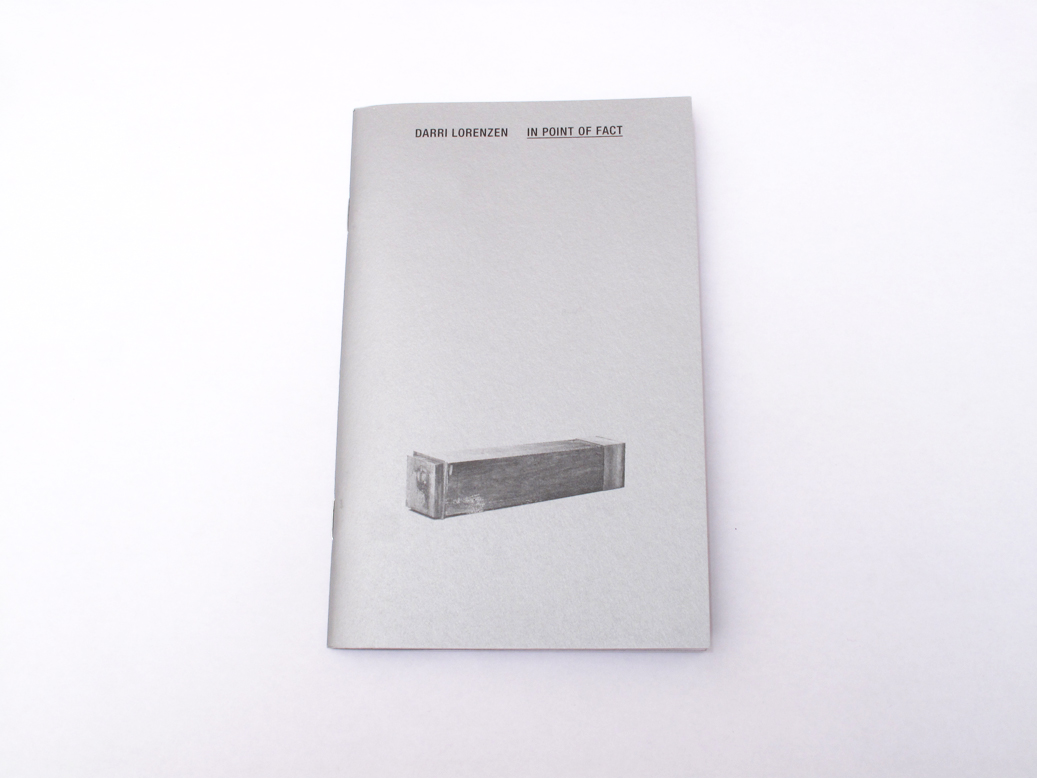
This booklet is published on the occasion of Darri Lorenzen’s exhibition In Point of Fact at Krome Gallery, December 12, 2009 through February 13, 2010.
EDITED BY Kathrin Meyer for Krome Gallery
All text by Kathrin Meyer, Seeing It conceived by Darri Lorenzen and Kathrin Meyer
COPYEDITING Tim Saltarelli
TRANSLATION Allison Plath-Moseley
GRAPHIC DESIGN Sara Hartman, John McCusker
3D RENDERING Timur Siqin
CONTRIBUTORS — Seeing It Benedict Andrews Oddny Eir Ævarsdóttir Margrét H. Blöndal Carson Chan
Rubén Grilo Elín Hansdóttir Joel Holmberg Matt Keegan Stephen Lichty Andri Snær Magnusson Björn Quiring Tim Saltarelli Sigurbjörg Þrastardóttir
PRINTING Brandenburgische Universitätsdruckerei und Verlagsgesellschaft Potsdam MBH
Darri Lorenzen thanks: Gregor Hose Michael Krome BJ Nilsen
Timur Siqin
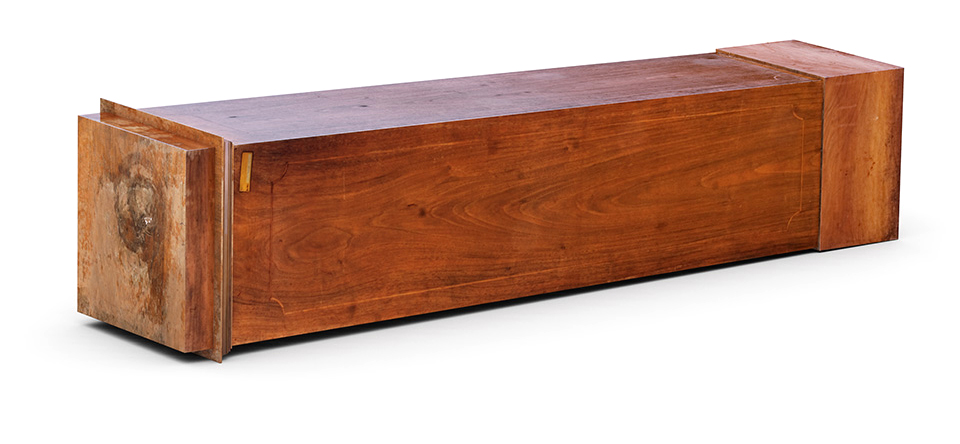
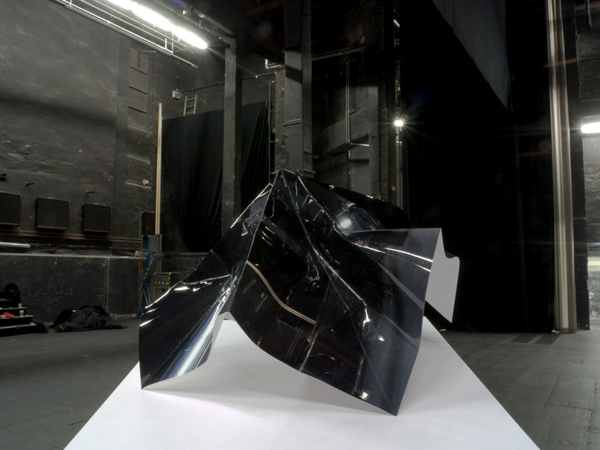
Cover image: Pedestal for the display of a bust of Karl Marx, taken from the Karl-Marx- Buchhandlung.
Inside cover: Installation photo by Darri Lorenzen.
Center spread: C-print of 3D rendering of gallery installation.
Copyright 2010 by Krome Gallery and the authors
PUBLISHED BY Krome Gallery Karl-Marx-Allee 82 10243 Berlin T. +49 (0)30 280 946 59 www.krome-gallery.com
All efforts have been made to contact the rightful owners with regards to copyrights.
001
43 |
|